OSRS production planning: materials, batches and XP
Before buying ingredients, separate the item quantity you want from the number of actions needed to make it. That distinction matters when an action produces several items. The production planner calculates the batch and material quantities together, then lets you carry a training goal into the same recipe.
How many ingredients do I need?
Choose the exact method, not only the output's name. A furnace recipe and a spell that make the same item can have different ingredients and experience rewards. Check the displayed facility and skill requirements before multiplying anything.
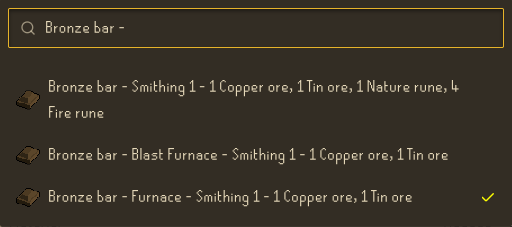
For a fixed output, the batch count is the requested quantity divided by output per action, rounded up. Materials are multiplied by that batch count. A partial final batch still uses the ingredients for a complete action.
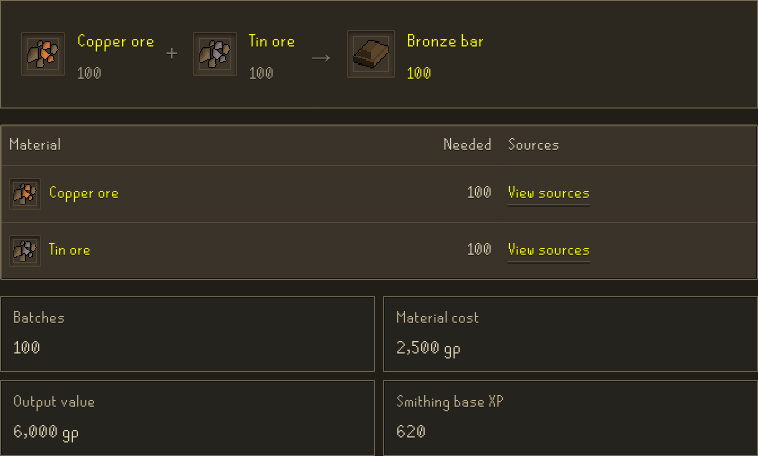
A bronze bar at a furnace is a simple example: each bar needs copper ore and tin ore. The example below uses the same recipe and arithmetic as the planner.
 Making 100 bronze bars
| Material | Needed |
|---|---|
| Copper ore | 100 |
| Tin ore | 100 |
- Batches
- 100
- Smithing base XP
- 620
Material estimate: 2,500 gp. Output estimate before tax: 6,000 gp. These use the available price snapshot, not a completed Exchange offer.
Open this batchChanging the quantity updates the materials and experience together. Follow a material’s item page to compare buying it with gathering it.
How do I turn a level goal into materials?
Start in the XP calculator. Pick the starting and target levels, then choose the training method. The action count rounds up so that the planned base experience covers the gap.
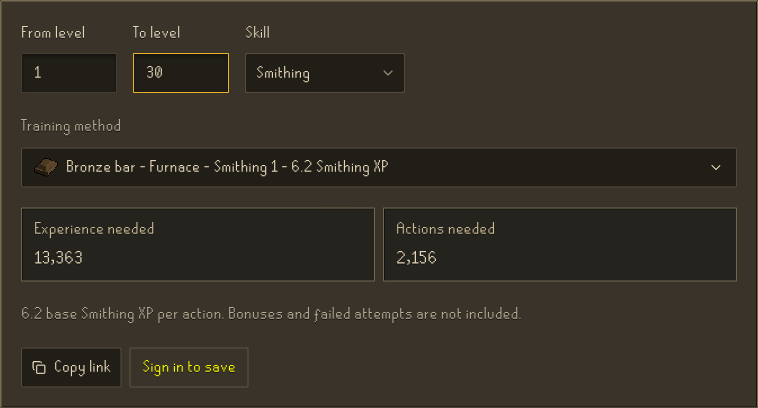
“Plan the materials” carries the selected method and its calculated quantity into the production planner. Returning with the browser's Back button restores the level goal. This avoids keeping a separate spreadsheet cell and recipe quantity in agreement by hand.
The example starts at the beginning of a level. Experience already earned within that level is not an input to this calculator. Bonuses and failed attempts are also outside this base-action estimate, so check the method before using the result as a shopping list.
Is output value the same as profit?
It is an estimate of the output's sale value before tax. The production planner uses the available high quote for buying ingredients and the low quote for selling the result. A quoted price does not guarantee an offer will fill at that price.
Material cost and output value are shown separately. To judge a method, also consider any Exchange tax, facility fees, supplies, failed actions and the time spent banking. The current planner does not turn those missing assumptions into a claimed hourly profit.
A missing price remains unknown rather than becoming zero. Likewise, an uncertain output quantity cannot support an exact batch calculation. The recipe and material links are still useful for investigating the missing detail.
The Grand Exchange guide explains the tax and spread distinction. Alchemy is another comparison, with its own payout and rune cost; do not substitute an alchemy payout for the output's market value.
How do I save or share the same batch?
Use “Copy link” to preserve the named recipe and quantity. A shared link takes precedence over a different plan already remembered in the recipient's browser. Signed-in players can save the current plan to their account and reopen it from their saved list.
An anonymous plan stays in this browser. Reopening a copied link is the useful fallback when browser storage is unavailable. There is no file to transfer or keep synchronized.
For the next comparison, open Smithing recipes, inspect a different named method, and repeat the same material and requirement checks.